
Speech Therapy for Kids in Sydney's Eastern Suburbs
Kids Spot use family focused goal setting to help your child develop a range of skills.
We work with children of all ages and abilities using proven techniques alongside a playful approach to help them reach their full potential.
What we offer
We offer a range of services in our Speech Pathology clinic to provide assistance at every step of your child’s journey. Speech Pathology for children can include:
Assessment and diagnosis
Therapy sessions (in clinic or at your child’s school / preschool)
Telehealth (online therapy)
Group programs or play pairs
Intensive therapy (daily sessions over a shorter block)
Professional development
Community participation
Feeding Therapy or Picky Eaters


How we conduct Assessments
Our assessments are tailored to your child’s needs.
We don’t believe in unnecessary testing and in some cases an assessment will look like a play session and the therapist will gather lots of important information using play and asking you specific questions.
All assessments include a written report or summary. You can check out more information about our assessments and fees here.
We believe that having written clarity about your child’s strengths and challenges will help you understand how your child engages with the world and why.
It also helps you to decide the most important goals to work towards for the biggest impact on functional skills.

Telehealth (online therapy)
Teletherapy is the delivery of services online. Research has found that teletherapy is proven to have the same outcomes as in-person therapy.
Some of the benefits of Telehealth therapy include:
No travel time or expenses
No long wait times or waiting rooms
You and your child can engage in the process from the comfort of your home
Telehealth sessions for young children are tailored to their needs.
Our therapists adapt activities to their learning style, interests & sensory preferences, keeping them actively involved.
If they’re too little to engage with the screen (e.g. 12-18 months), we have you COVERED! We switch our therapy model to parent coaching which is evidence-based practice for this age group.
Intensive therapy
We know that neurologically things that ‘Fire together, wire together’
Increasing the intensity of therapy increases the specific firing of messages within the nervous system. This supports faster acquisition of functional goals.
Our team understand the specific neuroscience behind foundational communication and can link this to quality aids and activities to improve functional outcomes. The aim of is to fast track your child’s progress through increasing the intensity of specific therapy.
Intensive therapy is focused on developing a specific skill for daily life. Progress is measured pre and post intensive.
Goals of Intensive Programs might include:

Clearer speech

Communication use*

Spelling & reading
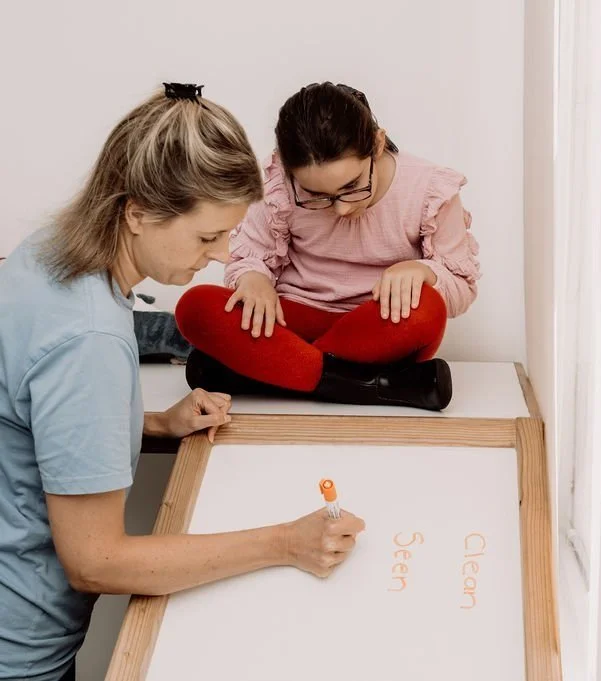
Writing skills
*(including the use of alternative communication devices)

Kids Spot use the principles of “responsive feeding” and incorporates elements of the S.O.S approach to feeding along with oral motor and sensory integration principles.
The aims of feeding therapy is to reduce meal time stress with the view to expanding your child’s willingness to experience new foods in a way that acknowledges the complex process that is eating.
What’s involved:
A 1 hour parent consultation
A 1 hour assessment including sharing a meal with your child
Clinic based therapy consultations that include a carer - on some occasions, these can also occur at home.
During each session you and your child will prepare and share a meal and engage in play and exploration of a range of foods
Weekly progress summaries detailing the skills you’ve learnt and strategies for integrating into the home.
Feeding Therapy
Our therapy techniques and training is varied, we specialise and have training in the following areas:
-
We use principles and therapy techniques such as:
DIR Floortime
Gestalt Language Processing (NLA Framework)
Intensive Interaction
Hanen - It Takes Two to Talk
Hanen - More than Words
-
We use principles and therapy techniques such as:
Phonology
Articulation
Dyspraxia - Nuffield Approach
-
We use Responsive Feeding principles that incorporate the planning aspects of the SOS Approach to feeding.
-
We use principles and therapy techniques such as:
The Lidcombe Program
Camperdown Program
Syllable Timed Speech
Michael Palin approach
-
The area of language is broad and complex. In summary it includes understanding and use of words, sentences and conversation. Our therapy approaches are tailored to your child’s needs and may incorporate principles of:
Colourful Semantics
Linda-Mood Bell
Hanen Programs
Word Aware
Robust Vocabulary Instruction
Story Champs
Language for Thinking
Metacognitive Approaches
TELL (Teaching Early Language and Literacy)
Inference Training (e.g., Blanks Levels of Questioning)
-
We use principles and therapy techniques such as:
Multi-sensory Literacy Instruction
Sounds-Write Program
Mulit-Lit
Orton-Gillingham Approach
Word Aware
-
We use principles and therapy techniques such as:
Play-Based Therapy approaches
Hanen (It Takes Two to Talk and More than Words)
DIR Floortime
Teach Me to Talk
Total communication approach
-
We support children to develop social skills in a manner that is respectful to their individual experience and goals. Commonly, speech therapy for kids, aims to change the way a child engages with those around them, failing to recognises individual differences and a child’s ability to tap into social rules. We acknowledge that all people communicate in different ways and support children to advocate for their way of socialising whist also being aware of how others socialise.
-
Karen Stagnetti play therapy
DIR Floortime
Hanen - It Takes Two to Talk
Hanen - More than Words
Let's Play! Interactive Play Guide (Play Project)
-
We use principles and therapy techniques such as:
Various Alternative communication Software (LAMP words for life / ProloQo2Go / TD Snap etc)
Key word sign
Signed Supported Speech
Picture supports and communication books
-
Designed to improve language comprehension, critical thinking, and expressive language by strengthening a child’s ability to create mental imagery while listening to or reading language.
-
Including but not limited to:
Down Syndrome
Williams Syndrome
Fragile X Syndrome
Prader-Willi Syndrome
Angelman Syndrome
CHARGE Syndrome
Rett Syndrome
Koolen-de Vries Syndrome
-
Global Developmental Delay (GDD) is a term used to describe a condition in children under five years old who experience significant delays in two or more developmental domains. These domains include physical development, cognitive development, communication, social and emotional development, and adaptive development. GDD is not a diagnosis itself but rather a descriptive term that indicates a child is not meeting developmental milestones as expected. It is important to note that GDD is not always indicative of intellectual disability, and with early intervention and support, many children with GDD can catch up to their peers.
-
Including but not limited to:
Cerebral Palsy
Stroke
Traumatic Brain Injury (TBI)
Dysarthria
Apraxia of Speech
Cleft Lip and Palate
-
Learning English as a second language can temporarily impact children's communication skills as they navigate two languages. This may involve initial delays in language development and challenges with pronunciation, grammar, and vocabulary in English. However, with support, these children often develop enhanced language awareness, improved problem-solving, and greater cultural sensitivity, ultimately enriching their communication abilities.
-
Glue ear (otitis media with effusion) can significantly impact a child's communication skills.
The fluid buildup in the middle ear can cause temporary hearing loss, which can affect speech development, language acquisition, and overall communication.
Children with glue ear may have difficulty hearing sounds clearly, leading to problems with pronunciation, understanding spoken language, and expressing themselves effectively.
This can sometimes result in frustration, behavioural issues, and even social difficulties.
Early detection and treatment are crucial to minimize the long-term impact on a child's communication development.
-
Social skills groups
Play pairs
Nature Groups